5 Fun AI Experiments You Can Do With Your Kids This Weekend: Common Mistakes to Avoid
Looking for a fun weekend activity? Explore the world of AI with your kids using these five easy experiments, plus essential tips to avoid common pitfalls.
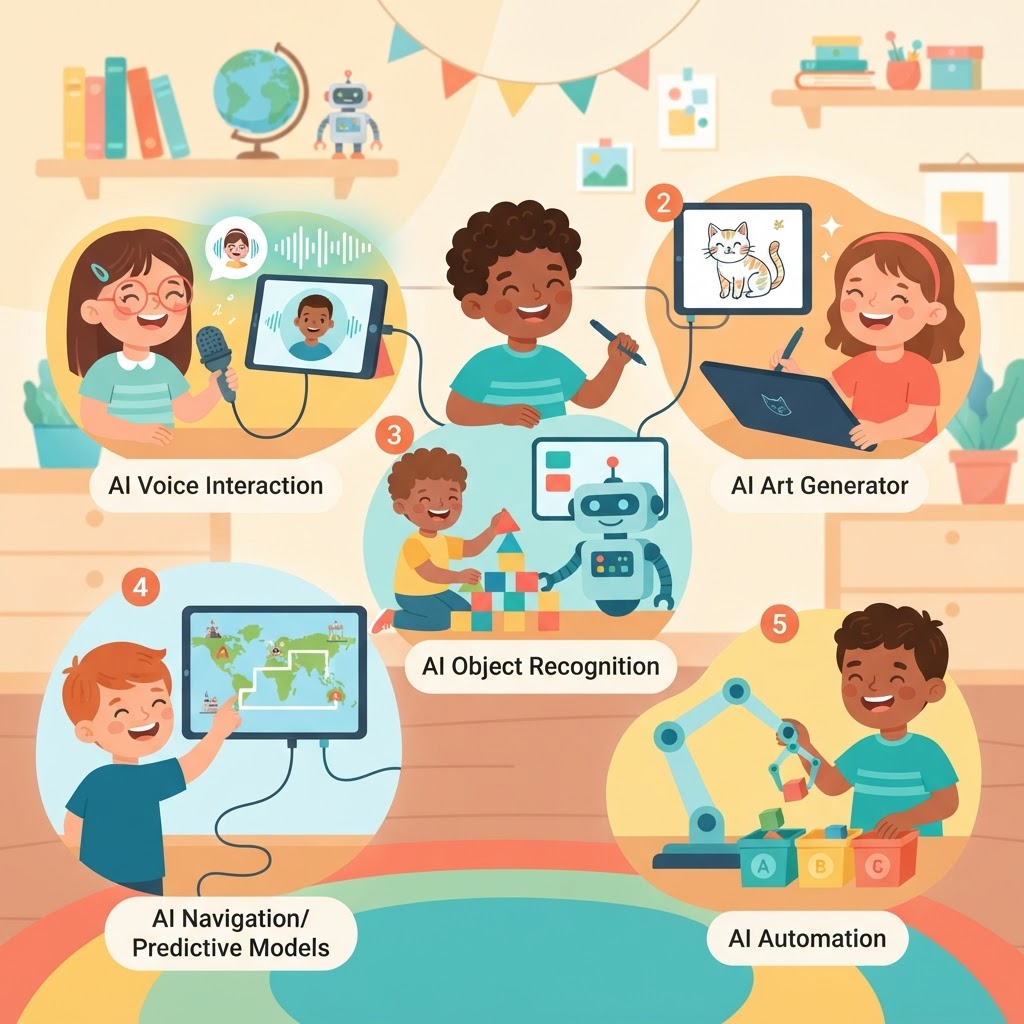
Why Hands-On AI Learning Changes Everything
Artificial intelligence isn't just a buzzword anymore — it's woven into the music your child streams, the games they play, and the search results they scroll through every day. Yet for most families, AI remains something that happens to them rather than something they actively explore and understand.
That's a missed opportunity.
When children experiment with AI concepts firsthand, something clicks. Abstract ideas become tangible. Curiosity replaces anxiety. And the dinner table conversation shifts from "What did you watch today?" to "Mum, did you know the computer is actually predicting what word comes next?"
This weekend, you don't need a robotics lab or a computer science degree to make that happen. You just need a few smart experiments, some common-sense guardrails, and the willingness to learn alongside your child.
The 5 Experiments (Plus What Parents Often Get Wrong)
1. Train Your Own Image Classifier
What to do: Use Google's free Teachable Machine tool. Let your child "teach" the computer to recognise two or three objects — their favourite toy, a coffee mug, a hand gesture. After a few minutes of showing examples, watch it recognise new ones in real time.
Why it works: This experiment makes the concept of machine learning visceral. Children see that the AI isn't magic — it's pattern recognition built from examples they provided.
Common mistake: Parents often jump straight to the activity without a 60-second explanation. Take a moment to ask: "If I showed you 100 photos of cats and 100 of dogs, could you learn to tell them apart? That's exactly what the computer is doing." That one sentence transforms the activity from a cool trick into a genuine learning moment.
2. Have a "Spot the AI Mistake" Session
What to do: Open any AI chatbot (with appropriate parental supervision) and deliberately ask it tricky, nuanced, or locally specific questions. Let your child catch the errors, correct them, and discuss why the AI got it wrong.
Why it works: Critical thinking about AI output is arguably the most important skill children can develop right now. This experiment builds healthy scepticism without breeding fear.
Common mistake: Many parents treat AI responses as either completely trustworthy or completely untrustworthy. Neither extreme helps. Guide your child toward a middle ground: "It's a useful tool, like a calculator. But just like a calculator can't tell you whether to buy something, AI has limits too."
Age tip: Younger children (6–9) enjoy spotting silly factual errors. Older children (10–16) can dig into why biases form in training data — a conversation that resources like GenAI Kids structure brilliantly for different age groups.
3. Build a Simple Decision Tree Together
What to do: No screen required for this one. Grab paper and draw a flowchart that helps "decide" something — what film to watch tonight, what to have for lunch, whether to take an umbrella. Ask: "Could a computer follow these rules?" Then talk about what a computer could never factor in (mood, a sibling's preference, the smell of rain).
Why it works: Decision trees are foundational to many AI systems. More importantly, this experiment shows children that rules-based thinking has real limits — which is precisely why human judgement remains irreplaceable.
Common mistake: Skipping the reflection conversation. The drawing is the warm-up; the discussion is the lesson. Ask: "What would our decision tree get wrong? What information is it missing?"
4. Play "AI or Human?" With Creative Work
What to do: Show your child three short poems, drawings, or short stories — some created by humans, some by AI tools. Challenge them to guess which is which, then reveal the answers and discuss the clues they noticed.
Why it works: This experiment sparks conversations about creativity, originality, and what makes human expression meaningful — topics that are increasingly important as AI-generated content floods the internet.
Common mistake: Framing this as a competition where "human wins." The richer conversation is: "What does this tell us about what creativity actually is? And what do we value about it?" There are no wrong answers, and children often surprise you with genuine insight.
5. Design Your Own AI — On Paper
What to do: Ask your child to invent an AI that solves a problem they care about. It could be an AI that detects when the dog needs a walk, recommends the perfect bedtime story, or warns them when their video game session has gone on too long. They sketch it, name it, and explain how it would learn.
Why it works: Design thinking about AI develops empathy, ethics, and systems thinking simultaneously. It also reveals what your child already understands — and where the gaps are.
Common mistake: Parents sometimes dismiss wild ideas. ("That's not how it really works.") Resist the urge. The goal isn't technical accuracy; it's imaginative engagement. You can gently introduce real constraints later. For structured follow-up, GenAI Kids offers age-appropriate modules that take these paper prototypes and connect them to actual AI concepts.
Practical Tips for a Smooth Weekend Session
- Start with 20 minutes, not two hours. Curiosity has a natural arc. End while they're still engaged.
- Sit beside them, not behind them. Your presence signals that this is a shared exploration, not a test.
- Use "I wonder" language. "I wonder why it got that wrong" opens doors. "That's wrong because..." closes them.
- Follow their lead. If one experiment grabs them, go deeper. The other four will still be there next weekend.
- Document it. A photo of their paper AI design or a screenshot of their image classifier in action becomes a proud artefact — and a brilliant conversation starter with teachers.
Key Takeaways
- Hands-on AI experiments are accessible to any family, regardless of technical background
- The most common parenting mistake is skipping the reflection conversation after each activity
- Critical thinking about AI output is a core skill, not an optional extra
- Age-appropriate framing matters — tailor your language to your child's developmental stage
- Paper-based activities are just as valuable as screen-based ones
- Platforms like GenAI Kids can extend weekend experiments into structured, progressive learning
Ready to Go Deeper?
One weekend of experiments plants the seed. What grows from it depends on the conversations you keep having — at the dinner table, in the car, whenever AI comes up in daily life.
The children who will thrive in an AI-shaped world aren't necessarily the ones who learn to use every tool. They're the ones who learn to think about every tool — who it was built for, what it gets wrong, and what problems it still can't solve.
That kind of thinking starts at home, this weekend, with a piece of paper or a free browser tab and a genuinely curious adult sitting right beside them.
Explore more guided activities and age-appropriate AI lessons at GenAI Kids — because understanding AI is a skill every child deserves.
Ready to Start Learning AI?
Join thousands of kids on GenAI Kids — free beginner lessons, no card needed.


