How GenAI Kids Turns Screen Time Into Learning Time: A Beginner-Friendly Roadmap
Turn your child's screen time into a powerful educational tool. Our beginner-friendly roadmap shows you how GenAI can spark curiosity and build new skills safely.

Screen time doesn't have to be a battle — it can be a bridge
GenAI Kids transforms passive screen time into structured, age-appropriate AI literacy by guiding children through hands-on lessons that build real skills — from understanding how algorithms work to writing their first prompt. Instead of watching children scroll endlessly, parents and educators can redirect that screen energy into something that genuinely prepares kids for the world ahead. The question isn't whether children will encounter AI in their lives; it's whether they'll understand it when they do.
But here's what most parents don't realise yet: the window for building that understanding comfortably and confidently is right now, in childhood — and the roadmap is simpler than you think.
Why Is Screen Time Such a Pain Point for Parents Right Now?
Most parents we speak with describe the same frustration: their child can spend two hours on a tablet without blinking, yet struggles to stay focused on anything that feels like "work." The guilt is real. The concern is valid. Screen time recommendations from paediatric organisations generally suggest that quality and context matter as much as quantity for school-aged children — and that's exactly the gap GenAI Kids was designed to fill.
The problem with typical screen time isn't the screen. It's the passivity. A child watching algorithmically served videos is being shaped by AI without knowing it. A child learning about AI — building prompts, questioning outputs, understanding why a chatbot gets things wrong — is developing critical thinking, digital literacy, and genuine curiosity. That's not a small distinction. That's the difference between a consumer and a creator.
And this is the curiosity loop worth sitting with: what if the same 45 minutes your child currently spends on YouTube could leave them understanding more about how recommendation engines work than most adults do? Keep reading — because by the end of this article, you'll have a concrete weekly plan to make that happen.
What Does an AI Curriculum for Kids Actually Look Like?
A well-designed AI curriculum for children isn't a watered-down computer science degree. It's a developmentally staged journey that meets children where they are — cognitively, emotionally, and in terms of prior knowledge.
At GenAI Kids, the curriculum is structured across three broad learning bands:
-
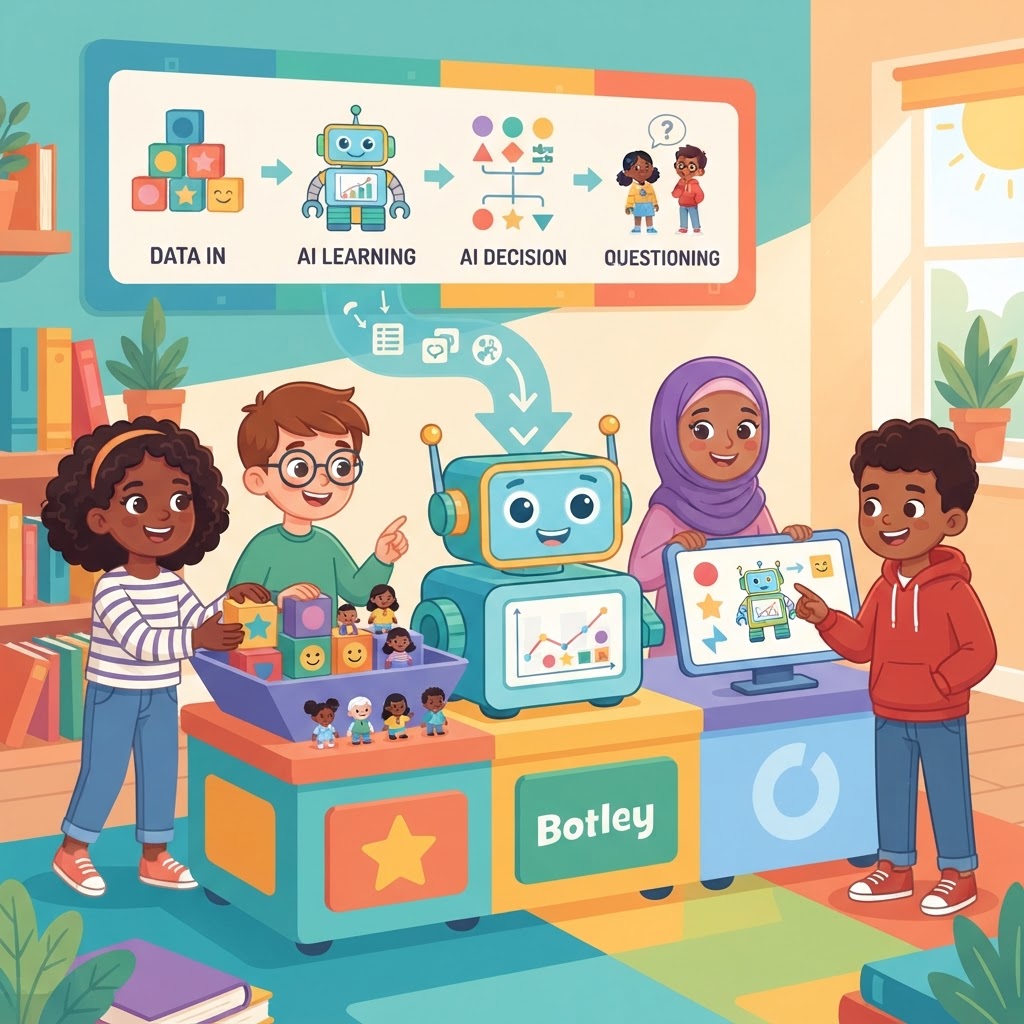
Ages 6–9 (Explorers): Foundational concepts — what is AI, how does it learn, what can it do and not do? Activities at this stage use storytelling, drawing prompts, and simple pattern recognition games. A 7-year-old might spend 20 minutes teaching a simple sorting "rule" to a pretend robot and then test whether the robot makes mistakes. This builds intuition for how machine learning actually works, long before any formal coding.
-
Ages 10–13 (Builders): Applied literacy — prompt engineering basics, understanding AI-generated content, recognising bias in outputs, and introductory ethics. A 12-year-old might compare two AI-generated paragraphs about the same topic, identify which one contains a factual error, and discuss why the AI made that mistake. This is media literacy for the AI age.
-
Ages 14–16 (Innovators): Critical creation — using AI tools responsibly to build projects, exploring how large language models are trained, and beginning to consider societal implications. A 15-year-old might design a simple AI-assisted research workflow and then audit it for potential bias or over-reliance.
Each stage builds on the last. A child who starts at age 8 and progresses through the curriculum arrives at 16 with a layered, nuanced understanding that most adults simply don't have.
Is Prompt Engineering Safe and Appropriate for Children?
Prompt engineering is the practice of crafting clear, specific instructions to guide an AI system toward a useful output — and yes, it is both safe and developmentally appropriate when taught in a structured environment.
Here's a clean definition worth bookmarking: Prompt engineering for kids is the age-appropriate practice of learning to communicate clearly and critically with AI tools in order to achieve better, safer, and more thoughtful results.
At the Explorer level, "prompt engineering" looks like a child learning that asking "tell me a story" produces a very different result than asking "tell me a funny three-sentence story about a dog who is afraid of butterflies." That's specificity, creativity, and cause-and-effect thinking — all wrapped in something that feels like play.
At the Builder and Innovator levels, it becomes more sophisticated: understanding tone, context, and how to spot when an AI is confidently wrong (a phenomenon sometimes called "hallucination"). Teaching children to question AI outputs rather than accept them wholesale is one of the most important critical thinking skills we can cultivate right now.
Safety is built into the curriculum at every stage. Lessons are designed around age-appropriate AI tools, with no direct unsupervised access to open-ended generative systems for younger learners.
How Much Screen Time Is Actually Needed — and When Does It Pay Off?
Parents reasonably want to know: how many sessions, how long, and how soon will I see a difference?
Based on the curriculum structure, meaningful AI literacy begins to show in children's thinking after roughly 8–10 structured sessions of 20–45 minutes each — depending on age and prior exposure. That's approximately four to six weeks if a family commits to two sessions per week, which fits comfortably within most after-school routines.
What does "showing up in their thinking" look like in practice? A 10-year-old who has completed the first Builder module will start asking questions like: "Did a person write this or did AI?" or "Why did it give that answer — what was it trained on?" These aren't abstract academic achievements. They're functional skills for navigating a world already saturated with AI-generated content.
The key is consistency over intensity. Two focused 30-minute sessions per week outperform a single two-hour binge every time — for retention, for enthusiasm, and for the kind of slow-burn curiosity that makes learning stick.
Practical Tips Parents Can Act On This Week
You don't need to overhaul your household routine. These five steps can be implemented immediately:
-
Audit one hour of current screen time. Pick a typical weekday evening and note what your child actually watches or plays for 30–60 minutes. Is it active or passive? Creative or consumptive? That honest snapshot is your baseline.
-
Replace one passive session with a structured lesson. Swap one YouTube session this week for a single GenAI Kids lesson. For children aged 8–10, the "How Does AI Learn?" introductory module takes under 25 minutes and generates immediate dinner-table conversation.
-
Ask one question after every session. "What did the AI get wrong today?" is more powerful than "What did you learn?" It trains scepticism and recall simultaneously.
-
Do a lesson yourself first. Spending 15 minutes on a module before your child does it means you can engage with their experience rather than observe it from a distance. Parents who co-learn see significantly higher child engagement in our experience.
-
Set a four-week micro-goal. Not "become an AI expert" — something specific, like: "By the end of the month, my child can explain in one sentence what a prompt is." Small, measurable, achievable.
FAQ: What Parents Ask Most About AI Education for Kids
At what age should children start learning about AI?
Children as young as 6 can begin exploring foundational AI concepts through age-appropriate activities like pattern games and storytelling prompts. The earlier children develop intuition for how AI systems work, the more naturally critical thinking about technology develops alongside it.
Will learning about AI make my child over-reliant on it?
A well-designed AI curriculum does the opposite — it teaches children to question, audit, and critically evaluate AI outputs rather than accept them. Understanding how AI makes mistakes is one of the core learning outcomes at every level of the GenAI Kids curriculum.
Do children need any prior coding knowledge?
No prior coding experience is required for the Explorer or Builder levels. The curriculum is designed to be accessible to complete beginners, with technical complexity introduced gradually and only when conceptually appropriate.
How is child safety managed within AI learning tools?
Structured curricula like GenAI Kids use age-gated content, educator-reviewed activities, and — for younger learners — guided rather than open-ended AI interactions. Children are never left to explore powerful generative tools without scaffolding and context.
Can this count toward school learning or homework time?
Many parents and educators find that AI literacy modules complement existing school subjects — particularly English (prompt writing), science (understanding data and algorithms), and PSHE (digital citizenship and ethics). While alignment varies by school system, the skills developed are directly transferable to formal education.
Key Takeaways
- Passive screen time builds habits; structured AI learning builds skills — the same device, radically different outcomes.
- Children aged 6–16 can engage meaningfully with AI literacy when content is developmentally staged.
- Prompt engineering is safe, age-appropriate, and builds critical thinking from the ground up.
- Consistency matters more than volume: two 30-minute sessions per week is a realistic and effective starting point.
- The goal isn't to produce AI engineers — it's to raise children who understand the systems shaping their world.
- Parents who engage alongside their children see better outcomes and stronger learning conversations at home.
The Roadmap Is Shorter Than You Think
The gap between a child who is shaped by AI and a child who understands AI is not years of study. It's a handful of well-designed lessons, a curious adult asking good questions alongside them, and a decision to treat screen time as a teachable resource rather than a necessary evil.
GenAI Kids exists precisely for this moment — when the technology is accelerating faster than most school curricula can follow, and parents are looking for something they can trust, start today, and actually enjoy doing with their child.
If you've read this far, you already care more than most. The next step is a small one: try a free lesson with your child this week. Twenty-five minutes. One concept. One conversation you wouldn't have had otherwise. That's where it starts.
Ready to Start Learning AI?
Join thousands of kids on GenAI Kids — free beginner lessons, no card needed.