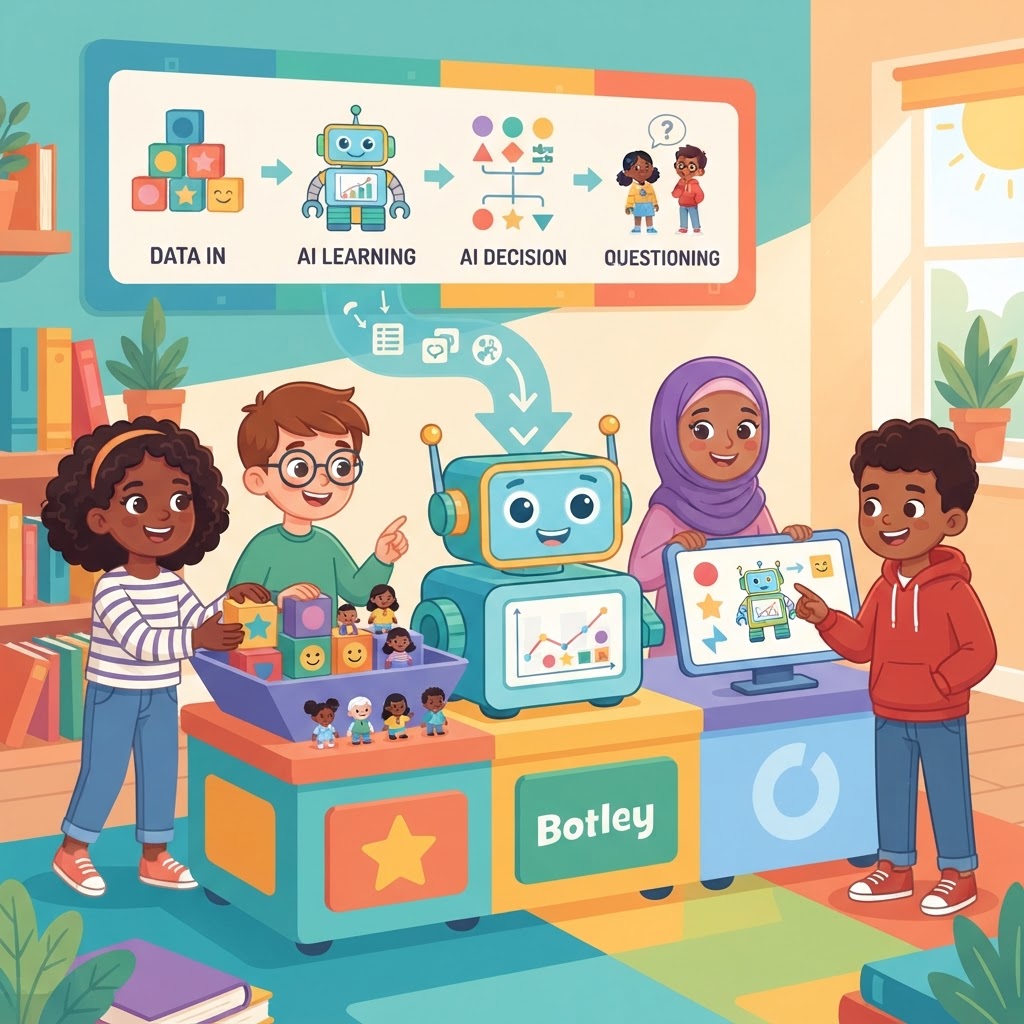
How GenAI Kids Turns Screen Time Into Learning Time: August 2026 Guide
Turn your child's screen time into a productive learning experience. Our August 2026 guide explores how GenAI tools foster creativity and new skills for kids.

The Screen Time Dilemma Every Parent Knows
If you've ever watched a child completely lose track of time while scrolling, gaming, or watching videos, you're not alone. Screen time is one of the most discussed — and debated — topics in modern parenting. But here's the thing: the problem has never really been screens. It's been the quality of what happens on them.
As we head into August 2026, AI literacy is no longer a "nice to have" skill for young people. It's quickly becoming as fundamental as reading and maths. The question worth asking isn't "how do we reduce screen time?" but rather "how do we make the screen time our children are already spending actually mean something?"
That shift in thinking changes everything.
Why AI Literacy Belongs in Every Child's Education
The world your child will graduate into looks radically different from the one you grew up in. AI tools are embedded in healthcare, creative industries, engineering, education, and everyday communication. By the time today's ten-year-old enters the workforce, understanding how AI works — and how to work with it — will be a baseline expectation in almost every profession.
Yet most school curricula are still catching up. A 2025 survey from the EdTech Research Consortium found that fewer than 30% of primary schools in English-speaking countries offered any structured AI education. That gap is significant, and it's one that forward-thinking parents and educators are already working to close at home.
What AI Literacy Actually Means for Kids
AI literacy isn't about training children to become programmers (though that's a wonderful outcome if it happens). It's about helping them:
- Understand how AI makes decisions — and why that matters for fairness and trust
- Think critically about AI-generated content — a skill that's urgently needed in an age of deepfakes and automated misinformation
- Use AI tools ethically and creatively — as collaborators, not just consumers
- Build problem-solving confidence — by exploring how machines learn from data
When children understand these concepts early, they develop a healthy, curious relationship with technology rather than a passive or anxious one.
Turning Passive Screen Time Into Active Learning
Most recreational screen time is passive. A child watches, clicks, or listens — but they're not genuinely creating, questioning, or building. The research on passive vs. active screen use is consistent: active engagement supports cognitive development, while extended passive consumption often doesn't.
The good news? Making the switch doesn't require dramatic changes to a family's routine.
Three Principles That Make the Difference
1. Replace, don't just restrict. Rather than fighting a losing battle to cut screen time entirely, try replacing one passive screen activity per day with something interactive. Swap thirty minutes of YouTube autoplay for a guided AI challenge or a short creative coding activity. Children rarely resist this swap when the alternative feels like a game.
2. Make learning visible. Ask your child to show you or explain what they've done on screen. This simple habit transforms a solitary activity into a shared conversation. It also reinforces learning — the act of explaining a concept consolidates understanding far more effectively than reading or watching alone.
3. Connect digital learning to the real world. When a child learns how a recommendation algorithm works, point to it in real life: "See how Netflix suggested that show? That's the kind of system you were learning about." These connections make abstract concepts stick — and they help children feel genuinely knowledgeable about the world around them.
How Structured AI Education Supports Whole-Child Development
Well-designed AI education for children isn't just about tech skills. It develops a surprisingly wide range of capabilities.
Critical thinking: Understanding that AI systems can be biased or wrong teaches children to question sources and evaluate information — skills that transfer across every subject.
Creativity: Many AI learning activities involve designing, building, or experimenting. Children learn that technology is something they can make with, not just consume.
Emotional intelligence: Age-appropriate lessons about AI in sensitive areas — healthcare, policing, social media — naturally spark conversations about ethics, empathy, and fairness.
Resilience: Debugging a simple AI model or understanding why a machine learning experiment didn't work exactly as expected builds tolerance for failure and persistence — two qualities that predict long-term success far more reliably than raw academic ability.
Platforms like GenAI Kids are designed with this whole-child approach in mind, structuring lessons so that children aged 6–16 build both technical understanding and the broader thinking skills that support it.
Practical Tips for Parents and Educators This August
Getting started doesn't need to be complicated. Here are some immediately actionable steps:
-
Audit one week of screen time. Before making changes, simply observe. Note what's passive, what's active, and where there's a natural opening to introduce something more engaging.
-
Start with curiosity, not curriculum. Ask your child what they've noticed about AI in daily life — voice assistants, photo filters, autocorrect. Their existing questions are the perfect entry point.
-
Set a "learning screen" time block. Even 20–30 minutes three times a week dedicated to structured AI learning creates meaningful cumulative progress over a school term.
-
Use the summer as a sandbox. August, with its looser schedule, is an ideal time to experiment with new learning activities without the pressure of homework and school commitments.
-
Explore GenAI Kids together. The platform's age-grouped curriculum makes it easy for parents and educators to find the right starting point, and doing the first few lessons alongside your child builds connection as well as knowledge.
Key Takeaways
- Screen time quality matters far more than quantity — active, structured learning has measurable developmental benefits
- AI literacy is becoming a foundational skill, yet most schools haven't caught up yet
- Replacing even small amounts of passive screen time with interactive AI learning creates meaningful long-term impact
- Well-designed AI education supports critical thinking, creativity, ethics, and resilience — not just technical skills
- August is a natural, low-pressure time to introduce new learning habits before the school year begins
Start the Shift Today
The children who will thrive in the coming decades aren't the ones who spent the least time with technology. They're the ones who learned to understand it, question it, and use it purposefully.
You have more influence over that outcome than you might think — and the right moment to start is always now. Explore what GenAI Kids has to offer, pick one small change to your child's screen routine this week, and watch what becomes possible when curiosity has somewhere meaningful to go.
Ready to Start Learning AI?
Join thousands of kids on GenAI Kids — free beginner lessons, no card needed.