Understanding AI Bias: Teaching Kids to Think Critically
Help your children become savvy digital citizens. Learn practical ways to teach kids how to identify AI bias and think critically about the technology they use every day.
Why AI Bias Matters for the Next Generation
Artificial intelligence is already part of your child's daily life — from the recommendations that appear on their favourite streaming service to the search results they browse for school projects. But here's something many parents and educators don't realise: AI systems can be biased, and those biases can shape what children see, believe, and think about the world.
Teaching kids to recognise and question AI bias isn't just a tech skill. It's one of the most important forms of critical thinking we can nurture in young people today. The good news? Children are remarkably capable of grasping these ideas when we give them the right tools and language to do so.
What Is AI Bias, and Where Does It Come From?
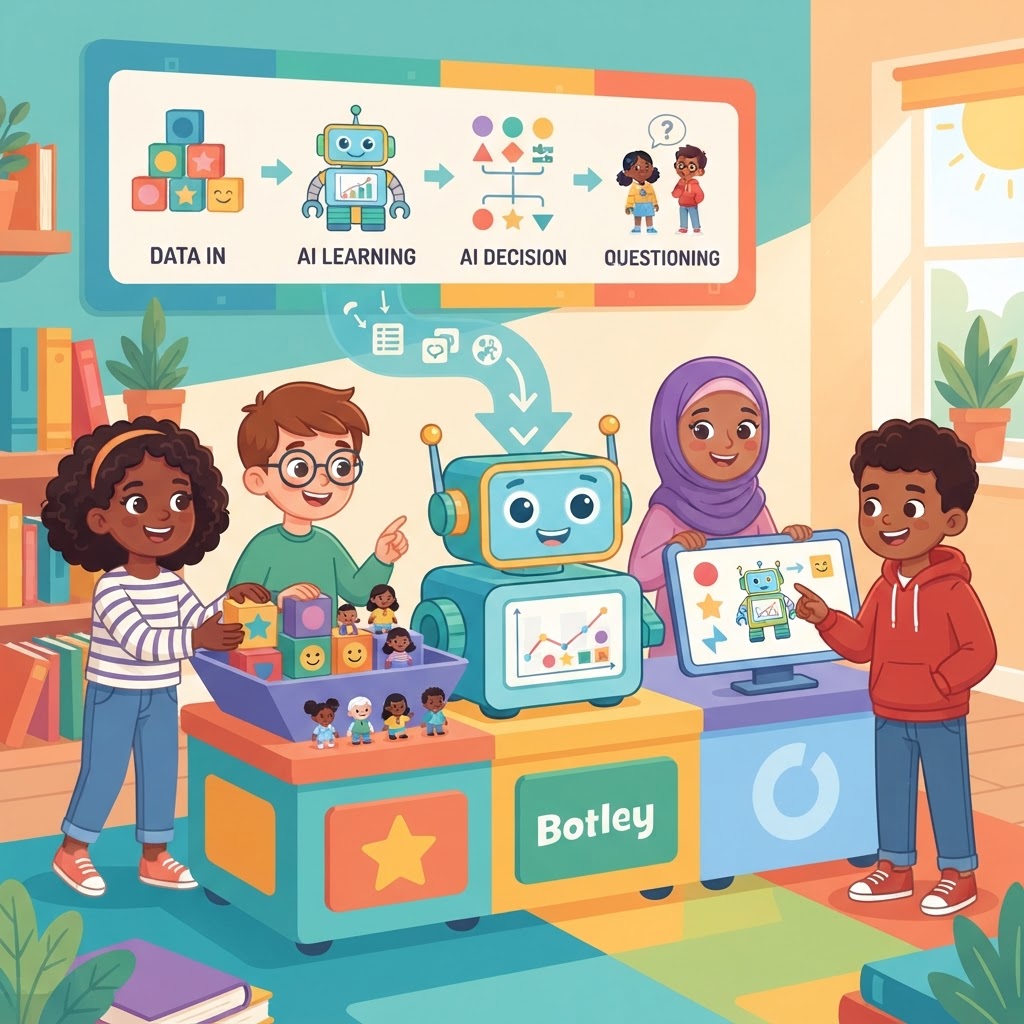
AI systems learn from data — enormous collections of text, images, videos, and human decisions. When that data reflects existing inequalities or gaps in representation, the AI learns and often amplifies those patterns. This is AI bias in its simplest form.
Common Sources of Bias
- Skewed training data: If an AI is trained mostly on images of doctors who are men, it may associate "doctor" with male faces — even when that doesn't reflect reality.
- Historical bias: Data drawn from the past can carry old prejudices into new technology, perpetuating stereotypes about race, gender, age, or ability.
- Representation gaps: When certain communities or viewpoints are underrepresented in the data, the AI essentially "doesn't know" they exist — and its outputs reflect that blind spot.
- Designer assumptions: The people who build AI tools bring their own unconscious perspectives to how systems are designed and evaluated.
Understanding these origins helps children move from passive consumers of technology to informed, questioning participants — which is precisely the mindset we want to cultivate.
How Bias Shows Up in Kids' Everyday Experiences
AI bias isn't an abstract concept confined to research labs. Children encounter it regularly, often without knowing it.
Search Engines and Image Results
Ask a child to search "scientist" or "CEO" in an image search engine. Older datasets still frequently return results dominated by a narrow demographic. This isn't a coincidence — it's a reflection of the data the AI was trained on. When children understand this, those results become a starting point for discussion rather than an unquestioned truth.
Recommendation Algorithms
Streaming platforms and social media feeds use AI to show content based on previous viewing habits. While this feels personalised and helpful, it can create "filter bubbles" — digital environments where children are only exposed to ideas, cultures, and perspectives that mirror what they already know. Over time, this can quietly narrow their worldview.
Autocomplete and Language Tools
AI writing assistants and autocomplete features can sometimes reinforce gendered or culturally loaded assumptions. A child using an AI writing tool might notice it consistently suggests certain careers for male characters and others for female characters — a subtle but meaningful form of bias.
Platforms like GenAI Kids are designed to help children spot exactly these kinds of patterns, turning everyday digital moments into teachable opportunities.
Talking to Kids About AI Bias: Age-Appropriate Approaches
One of the most common questions we hear from parents is: "How do I even start this conversation?" The answer is simpler than you might think — start with curiosity, not alarm.
For Younger Children (Ages 6–9)
Use concrete, relatable examples. Ask questions like: "Do you think this app always shows fair things? Why or why not?" Introduce the idea that computers learn from people, and sometimes people make mistakes — so computers can make mistakes too. Keep it playful. You might compare a biased AI to a friend who has only ever read one type of book and thinks that's all there is.
For Tweens (Ages 10–12)
Children in this age group can begin exploring the concept of fairness more deeply. Encourage them to test AI tools themselves. Try the same search with different keywords and compare results. Ask: "Who do you think created this? What might they have missed?" This is an excellent age to introduce the idea that no technology is neutral — it always reflects choices made by people.
For Teenagers (Ages 13–16)
Teens can engage with the ethical and societal dimensions of AI bias. Discuss real-world examples: hiring algorithms that have disadvantaged certain candidates, facial recognition technology that performs less accurately on darker skin tones, or health AI tools trained predominantly on data from one demographic. Encourage them to ask: "Who benefits from this system? Who might be harmed?" These are the questions that shape responsible future technologists and citizens.
GenAI Kids offers structured learning pathways across all these age groups, helping young people develop a fluent, critical relationship with AI from an early age.
Practical Tips for Parents and Educators
You don't need to be a technology expert to help children think critically about AI. Here are some straightforward strategies you can use right now:
- Make questioning a habit. Whenever your child uses an AI tool, ask: "Where do you think that answer came from? Could it be wrong?"
- Compare sources. Show children that different AI tools can give different answers to the same question — proof that no single system holds the whole truth.
- Celebrate mistakes as learning moments. When an AI produces a biased or bizarre result, treat it as a discovery, not a problem. "Interesting! Why do you think it said that?"
- Diversify digital diets. Actively seek out content, creators, and perspectives that fall outside your child's usual algorithm-generated recommendations.
- Model critical thinking yourself. Let children see you questioning technology, checking facts, and acknowledging uncertainty.
- Use dedicated learning platforms. Resources like GenAI Kids provide age-appropriate, curriculum-aligned content that makes these conversations structured and engaging rather than overwhelming.
Key Takeaways
- AI bias occurs when AI systems reflect and amplify the inequalities or gaps present in their training data.
- Children encounter AI bias every day through search engines, recommendation algorithms, and language tools.
- Age-appropriate conversations — rooted in curiosity rather than fear — are the most effective way to build critical thinking skills.
- Parents and educators don't need technical expertise to help children question AI; they need good questions and consistent habits.
- Teaching AI literacy, including bias awareness, is one of the most future-relevant skills we can give young people today.
Raising Thoughtful Digital Citizens
AI is not going away — and we wouldn't want it to. Used wisely, it is an extraordinary tool. But "wisely" is the key word. Children who understand how AI works, where it can go wrong, and whose voices it may be missing are children who are genuinely prepared for the world ahead.
These conversations don't need to be heavy or technical. They can be curious, creative, and even fun. The goal isn't to make children afraid of technology — it's to make them confident, thoughtful, and fair-minded in how they use it.
Start the conversation today. Explore what your child already knows about AI, ask a question together, and see where it leads. And if you're looking for a trusted, child-friendly space to continue that learning journey, take a look at what GenAI Kids has to offer — because understanding AI is a skill every child deserves.
Ready to Start Learning AI?
Join thousands of kids on GenAI Kids — free beginner lessons, no card needed.


