How to Explain Machine Learning to Your 10-Year-Old: 2026 Parent Guide
Help your child understand the future of technology with these simple, fun, and engaging explanations designed specifically for 10-year-olds.
Why Machine Learning Is No Longer Just for Tech Adults
Not long ago, "machine learning" was a phrase reserved for university lecture halls and Silicon Valley boardrooms. Fast forward to 2026, and your child is already interacting with machine learning dozens of times a day — every time a streaming service suggests their favourite show, every time a voice assistant answers a question, every time a photo app recognises a friend's face.
The exciting news? Children are naturally brilliant at grasping machine learning concepts. They just need the right language, the right examples, and a grown-up willing to have the conversation. This guide gives you everything you need to make that happen.
What Machine Learning Actually Is (In Plain English)
Before you can explain it to your child, it helps to feel confident yourself.
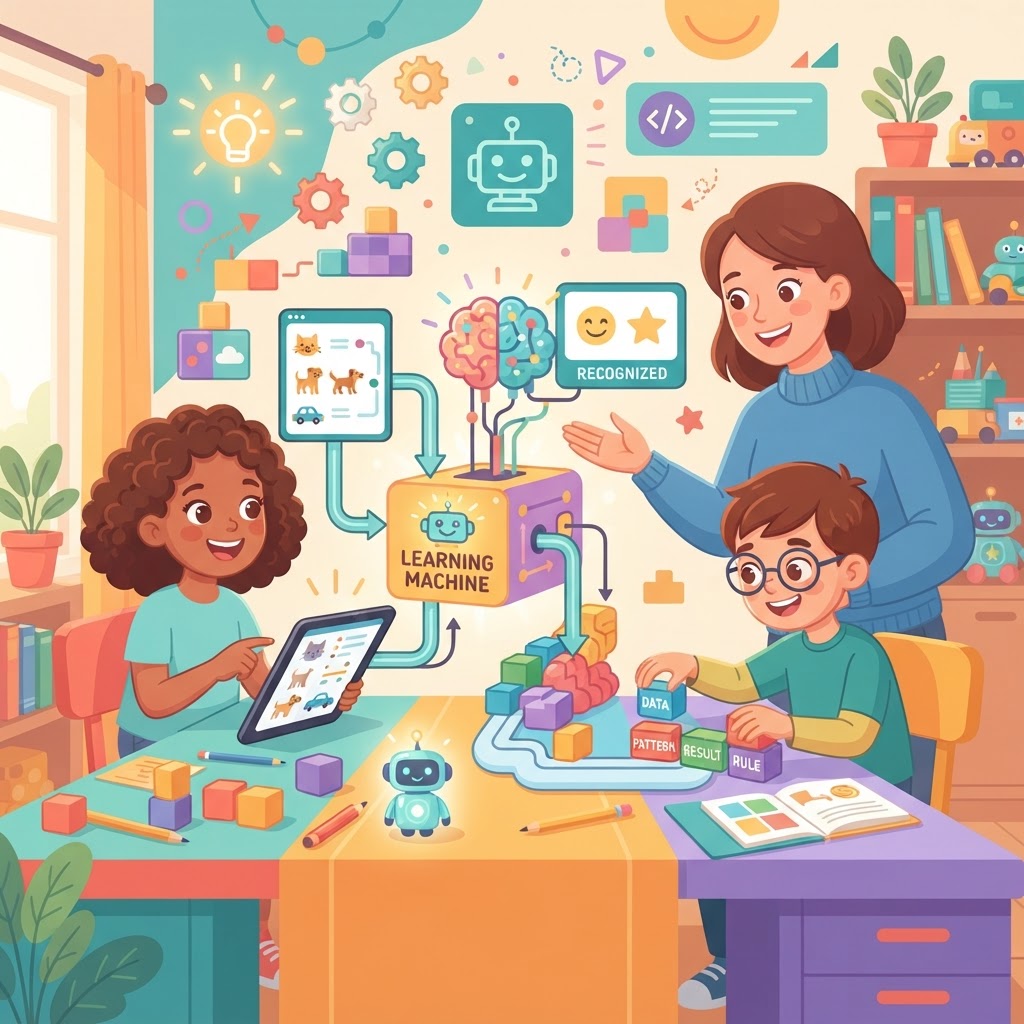
Machine learning is a type of artificial intelligence where computers learn from experience — rather than being told exactly what to do at every step. Instead of a programmer writing millions of specific rules, the computer is shown thousands of examples and figures out the patterns on its own.
Think of it like teaching a dog to fetch. You don't hand the dog a manual. You throw the ball, reward the right behaviour, and over many repetitions the dog learns. Machine learning works on the same principle, just with data instead of dog treats.
The Three Big Ideas to Grasp First
- Data is the fuel. Machines learn from enormous collections of information — images, words, sounds, numbers.
- Patterns are the magic. The computer finds repeating patterns inside that data, just like your child spots patterns in a game.
- Improvement is the goal. The more examples a machine sees, the better it gets — it keeps adjusting until it's accurate.
Once you feel comfortable with these three ideas, you're ready to pass them on.
How to Explain Machine Learning to a 10-Year-Old
Start With Something They Already Love
The golden rule of explaining any complex topic to children is to anchor it in something familiar. Here are a few conversation starters based on common interests:
- Gaming: "You know how some game characters seem to get smarter as you play? That's machine learning — the game is watching how you move and adjusting."
- Music or video streaming: "Remember how Spotify knew you'd love that song even before you'd heard it? It studied millions of listeners and spotted a pattern that matched your taste."
- Spam filters: "Ever notice how junk emails don't usually end up in your main inbox? A machine learned what spam looks like by reading millions of emails."
Choose the example that makes your child's eyes light up, and start there.
Use a Simple, Hands-On Analogy
One of the best analogies for machine learning is the sorting game. Try this at home:
- Gather a pile of mixed items — coins, buttons, or even fruit.
- Show your child a rule without saying what it is (for example, separate round things from non-round things).
- After a few examples, ask them to guess the rule and sort the next item themselves.
Congratulations — your child just simulated machine learning. The machine is the child, the examples are the training data, and the rule they discovered is the pattern. This short activity makes an abstract concept immediately tangible.
Introduce the Idea of Mistakes and Improvement
One thing children find genuinely reassuring about machine learning is that making mistakes is part of the process. Early on, a machine learning model gets things wrong — a lot. But each mistake teaches it something.
You can draw a direct parallel to learning to ride a bike, practise spelling, or master a maths table. "Machines learn the same way you do — by trying, getting it wrong sometimes, and trying again." This framing also builds a healthy attitude toward failure in your child's own learning.
Practical Ways to Keep the Learning Going
Understanding machine learning once isn't enough — like any new language, children need ongoing exposure to make it stick. Here are actionable ways to weave it into everyday life:
- Ask "How does it know that?" regularly. When technology surprises your child — a recommended video, a personalised advert, a suggested route on maps — pause and ask together: "How do you think it figured that out?"
- Watch AI in action together. Sites like Google's Teachable Machine let children train a simple model themselves in minutes. Seeing a computer learn to recognise their hand gestures in real time is genuinely thrilling.
- Read and explore structured resources. Platforms like GenAI Kids offer age-appropriate lessons that walk children aged 6–16 through AI and machine learning concepts in a structured, engaging way — ideal for parents who want expert-guided content without the guesswork.
- Encourage questions without pressure. If your child asks something you can't answer, treat it as a team investigation. "I don't know — let's find out together" is one of the most powerful phrases in a parent's toolkit.
Key Takeaways
- Machine learning is already part of your child's daily life — naming it helps them understand the world around them.
- The best explanations start with examples your child already cares about.
- Hands-on activities (like the sorting game) make abstract ideas concrete and memorable.
- Framing mistakes as part of learning builds both AI literacy and a resilient mindset.
- Consistent, curious conversations matter more than one perfect explanation.
- Structured resources like GenAI Kids can support the learning journey with expert-designed content built specifically for young learners.
The Conversation Is the Curriculum
You don't need a computer science degree to raise an AI-literate child. You need curiosity, a willingness to explore together, and a few good starting points — all of which you now have.
Machine learning isn't a topic to save for secondary school or university. Children who understand these ideas early develop stronger critical thinking skills, ask better questions about the technology they use, and feel confident rather than overwhelmed as AI continues to shape the world.
Start small. Start with what they love. And if you'd like structured support along the way, GenAI Kids is designed exactly for moments like this — turning big ideas into lessons that children genuinely enjoy.
The best time to start this conversation? It's right now, over dinner tonight.
Ready to Start Learning AI?
Join thousands of kids on GenAI Kids — free beginner lessons, no card needed.


