Integrating AI Literacy Into Your Home School Curriculum
Enhance your home school curriculum by integrating AI literacy. Learn essential tips to prepare your child for a tech-driven future.
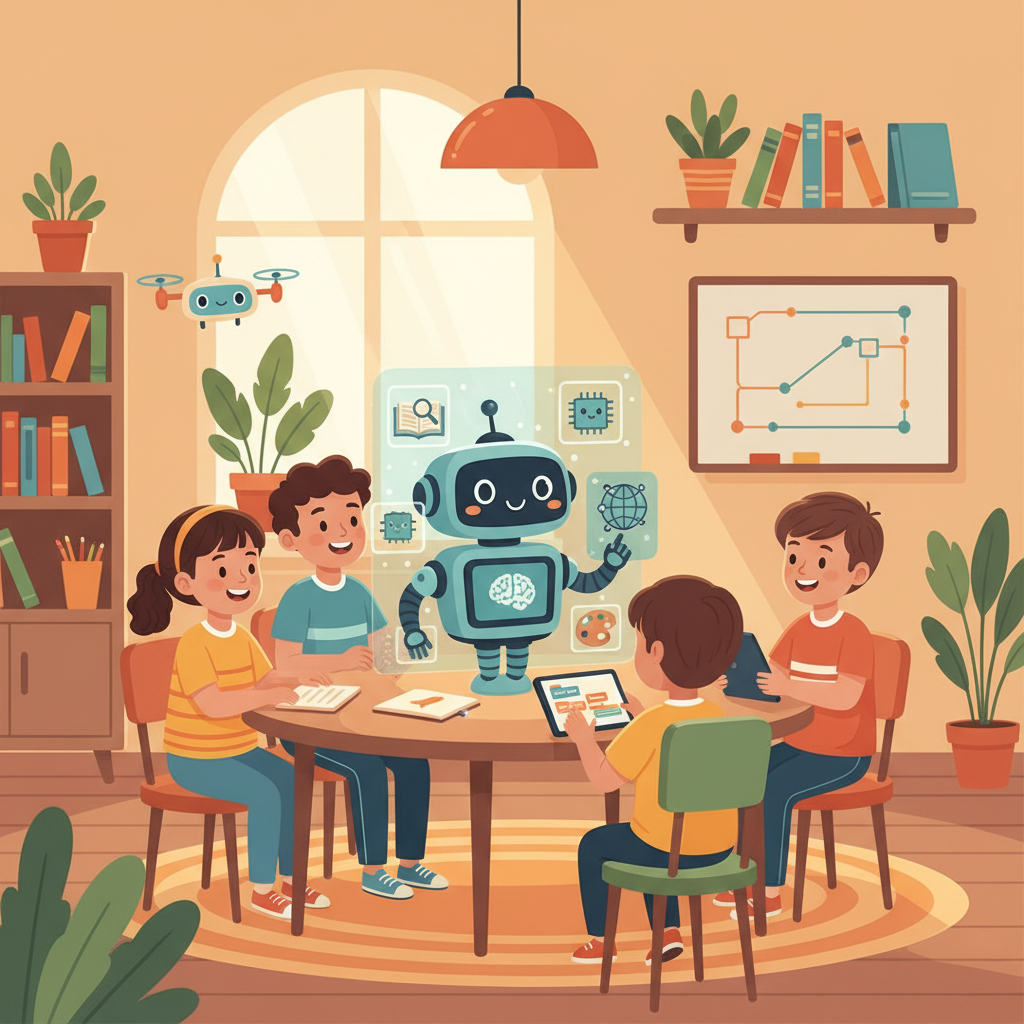
Why AI Literacy Belongs in Your Home School
If you've watched your child chat with a voice assistant, use autocomplete on a tablet, or marvel at an AI-generated image, you've already witnessed artificial intelligence weaving itself into everyday life. For home-educating families, this creates a remarkable opportunity — and a genuine responsibility.
AI literacy isn't about turning children into programmers overnight. It's about helping them understand the tools shaping their world, ask smart questions, and make thoughtful choices as digital citizens. The great news? You don't need a computer science degree to teach it. With the right resources and a little planning, AI concepts fit naturally alongside maths, science, language arts, and even philosophy.
What AI Literacy Actually Means for Young Learners
Before building AI topics into your curriculum, it helps to know what you're actually teaching.
More Than Just Technology
AI literacy encompasses three interconnected skills:
- Understanding — knowing what AI is, how it learns from data, and where it shows up in daily life
- Using — applying AI tools responsibly and effectively
- Evaluating — thinking critically about AI outputs, recognising bias, and questioning the ethics behind automated decisions
For a six-year-old, this might look like noticing that a streaming service "guesses" what show they want to watch next, and wondering why it does that. For a fifteen-year-old, it might mean exploring how facial recognition works — and debating whether it should be used in schools.
Age-Appropriate Progression
One of the biggest advantages of home education is the freedom to meet children exactly where they are. AI literacy scales beautifully:
- Ages 6–8: Pattern recognition, sorting, simple "if-then" thinking, and playful exploration of how computers learn
- Ages 9–12: Algorithms, data, how search engines work, and introductory machine learning concepts
- Ages 13–16: Neural networks, AI ethics, bias in datasets, and real-world applications in medicine, climate science, and the arts
Weaving AI Into Subjects You Already Teach
You don't need to create an entirely new curriculum block for AI. The most effective approach is integration — threading AI concepts through the subjects your family already covers.
Mathematics and Logic
AI runs on maths, and the connection can make abstract concepts feel immediately relevant. When teaching probability, discuss how spam filters decide which emails to block. When exploring statistics, examine how recommendation algorithms use data patterns. Younger children can sort objects by multiple attributes to build the intuition behind classification — a core machine learning concept — without a screen in sight.
English and Critical Thinking
Ask your child to compare a piece of writing generated by an AI tool with one they wrote themselves. What's different? What's missing? This exercise sharpens analytical skills, deepens their appreciation of human creativity, and opens genuinely fascinating conversations about voice, intention, and authenticity. You might also explore how AI is used in journalism and discuss the importance of verifying information sources — a media literacy skill with lifelong value.
Science and the Natural World
AI is transforming scientific research. From tracking endangered species with image recognition to predicting extreme weather events, the applications are concrete and compelling. Use these stories as reading comprehension exercises or springboards for project-based learning. Older students might investigate how AlphaFold — an AI system — solved one of biology's greatest puzzles by predicting protein structures, effectively accelerating decades of research.
Ethics and Social Studies
Perhaps the richest conversations around AI are ethical ones. Who benefits when AI makes hiring decisions? What happens when an algorithm contains bias? Should AI be allowed to create art and claim credit? These questions don't have tidy answers, which makes them perfect for Socratic discussions, debate practice, and developing the moral reasoning skills that matter far beyond the classroom.
Practical Tips for Getting Started
Integrating AI literacy needn't feel overwhelming. Here's a straightforward path forward.
Start with observation, not instruction. Spend a week simply pointing out AI in your daily life — the autocorrect on your phone, the route suggested by your GPS, the product recommendations on a shopping site. Building awareness comes before formal learning.
Use structured resources designed for children. Platforms like GenAI Kids are built specifically to make AI concepts accessible and age-appropriate, giving you a ready-made scaffold to work from rather than building lessons from scratch.
Make it hands-on wherever possible. Unplugged activities — like training a "human algorithm" to sort playing cards, or playing games that simulate how computers make decisions — are often more memorable than screen-based lessons alone.
Encourage questions over answers. AI is a fast-moving field. The goal isn't to memorise facts that may be outdated next year; it's to build the habit of curious, critical inquiry. Reward "I wonder why..." and "But what if..." thinking enthusiastically.
Connect to your child's interests. A child passionate about animals will engage more deeply with AI-powered conservation projects. A budding musician might explore how AI composes music. Relevance is the most powerful motivator in any curriculum.
Document and reflect. Keep a simple AI learning journal — a notebook where your child records new concepts, interesting questions, and their own opinions. This doubles as a portfolio and helps consolidate understanding over time.
Key Takeaways
- AI literacy covers understanding, using, and critically evaluating artificial intelligence — not just coding
- Home educators have the unique advantage of integrating AI concepts across existing subjects rather than treating it as an isolated topic
- Lessons can be scaled meaningfully from age six through to sixteen
- Unplugged, discussion-based, and project-led activities are just as valuable as digital ones
- Resources like GenAI Kids provide age-appropriate, structured support so you're not starting from zero
- The most important skill you can cultivate is your child's habit of asking thoughtful questions about the technology around them
Your Next Step
The world your children are growing into will be shaped — profoundly — by artificial intelligence. Home education gives you the rare gift of weaving that understanding into everything they learn, in a way that is personal, deep, and genuinely meaningful.
You don't need to know everything about AI to start. You just need to be willing to learn alongside your child — which, if you're honest, is the best kind of teaching there is.
Explore the curriculum resources at GenAI Kids to find age-grouped lessons, activities, and guides designed to make this journey straightforward, engaging, and fun. Your family's AI literacy adventure starts today.
Ready to Start Learning AI?
Join thousands of kids on GenAI Kids — free beginner lessons, no card needed.


