The Best Age to Start Learning AI: A Parent's Guide
Wondering when your child should start learning AI? This guide provides insights to help parents choose the right time and approach for their kids.
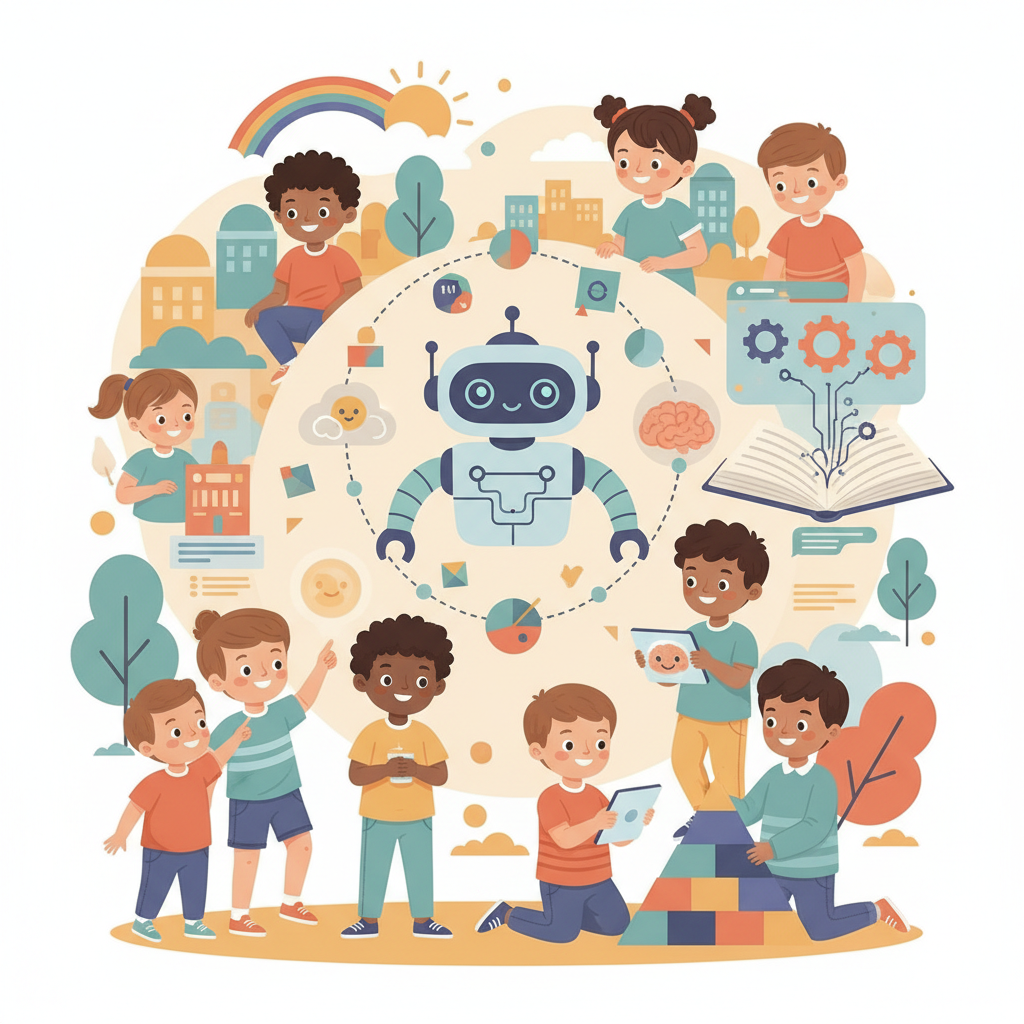
Why AI Education Is a Conversation Every Parent Should Be Having Right Now
Artificial intelligence isn't coming — it's already here. It's in the apps your child uses to learn spelling, the recommendations that pop up on their favourite streaming service, and the voice assistant they casually ask for homework help. Yet most children interact with AI every single day without understanding the first thing about how it works.
That gap between using technology and understanding it matters more than many parents realise. And increasingly, educators and child development experts are asking the same urgent question: when is the right time to start teaching kids about AI?
The good news? There's no single "magic age" — but there is a clear developmental roadmap to guide you, and it's more approachable than you might think.
Understanding How Children Learn Technology at Different Ages
Before we talk about AI specifically, it helps to understand how children relate to technology as their brains develop. Children aren't just small adults — their capacity for abstract thinking, cause-and-effect reasoning, and creative problem-solving grows in distinct stages.
Ages 5–7: Planting the Seeds of Curiosity
At this age, children are natural explorers. They don't need to understand algorithms — they need to build a relationship with curiosity. Simple concepts like "computers follow instructions" or "robots can learn from examples" are genuinely meaningful to a five-year-old, especially when introduced through play, stories, and hands-on activities.
Think of this stage as laying the emotional and conceptual groundwork. Children who grow up asking "how does that work?" become the teenagers who want to find out.
Ages 8–11: Making Connections and Building Logic
This is a golden window for introducing structured AI concepts. Children this age can begin to understand that AI learns from data, that patterns matter, and that machines don't actually "think" the way humans do — they process information in clever ways.
Activities like simple coding, puzzle-solving, and age-appropriate explanations of machine learning are genuinely accessible here. This is also when children begin to ask ethical questions naturally: "Is it fair if a computer makes a decision about someone?" Those questions are worth encouraging.
Ages 12–16: Developing Real Skills and Critical Thinking
By early adolescence, young people can engage with AI at a meaningful, practical level. They can explore how AI models are trained, experiment with basic tools, understand concepts like bias in data, and even build simple projects of their own.
This is the age where curiosity can convert into genuine capability — and where platforms like GenAI Kids offer structured learning pathways that challenge teenagers without overwhelming them.
The Case for Starting Earlier Than You Think
Many parents assume AI education belongs in secondary school or university. But research into STEM learning consistently shows that early exposure — even informal, playful exposure — shapes a child's confidence and long-term engagement with the subject.
Consider how we approach reading. We don't wait until children are ten to introduce them to books. We read to them as toddlers, we let them play with letters, we make stories exciting long before they understand grammar. AI literacy deserves the same layered approach.
Starting conversations early doesn't mean pressuring your six-year-old into coding bootcamps. It means:
- Asking "what do you think made the app suggest that video?" during everyday screen time
- Watching age-appropriate documentaries about robots and technology together
- Playing logic and strategy games that build computational thinking skills
- Celebrating curiosity over correct answers
These small, consistent conversations accumulate into something powerful over time.
What Good AI Education Actually Looks Like at Each Stage
The how matters just as much as the when. AI education that works for children is hands-on, contextual, and connected to things they already care about.
For Younger Children (5–8)
Focus on unplugged activities — games, storytelling, and physical activities that teach the logic behind AI without a screen. Sorting games, pattern recognition exercises, and "if-then" decision trees can all introduce core concepts in genuinely fun ways.
For Middle Childhood (8–12)
Introduce creative coding and visual tools. Platforms that use block-based coding allow children to build simple AI-like systems — a chatbot that responds to certain words, or a programme that "learns" to sort images — without needing to write complex code from scratch.
At this stage, discussion is equally important. Talk about where AI appears in daily life, and start conversations about fairness, privacy, and the difference between what AI can do and what it should do.
For Teenagers (12–16)
Encourage project-based learning and real-world application. Teenagers engage best when they can connect learning to their own interests — whether that's music, sport, gaming, or social justice. A teen who cares about climate change, for example, can explore how AI is being used to monitor deforestation. That personal connection transforms abstract concepts into meaningful knowledge.
GenAI Kids is designed with exactly this kind of age-sensitive, interest-led approach — offering content that grows with your child from foundational curiosity right through to more advanced exploration.
Practical Tips for Parents and Educators
You don't need to be a tech expert to support your child's AI education. Here are some practical starting points:
- Make it conversational. Ask open questions about technology during everyday moments — in the car, at dinner, during screen time.
- Model curiosity yourself. Say "I don't know — let's find out together" rather than changing the subject when tech questions come up.
- Choose quality resources. Look for platforms that prioritise age-appropriateness, safety, and genuine learning over entertainment alone.
- Balance use with understanding. Encourage your child not just to use apps, but to think about how they work.
- Connect it to values. Conversations about AI are also conversations about fairness, honesty, and what kind of future we want to build.
Key Takeaways
- There is no single "right age" to start — different developmental stages call for different approaches
- Ages 5–7 are ideal for planting curiosity; ages 8–11 for structured concepts; ages 12–16 for real skills
- Early, informal exposure builds long-term confidence and engagement
- The best AI education is hands-on, contextual, and connected to children's own interests
- Parents don't need to be tech experts — curiosity and open conversation are the most powerful tools you have
- Structured platforms like GenAI Kids can provide age-appropriate pathways that grow with your child
The Future Belongs to the Curious
AI will shape the world your child inherits in ways we can barely predict. The children who will thrive aren't necessarily the ones who learned to code first — they're the ones who grew up asking good questions, thinking critically, and feeling comfortable with complexity.
Starting that journey doesn't require a curriculum overhaul or an expensive course. It starts with a conversation at the dinner table, a question about a favourite app, or an afternoon exploring something new together.
Ready to give your child a head start? Explore GenAI Kids today and discover learning pathways designed to meet your child exactly where they are — and take them somewhere extraordinary.
Ready to Start Learning AI?
Join thousands of kids on GenAI Kids — free beginner lessons, no card needed.


