The Best Free Resources to Learn AI Online for Kids
Help your child build the skills of the future with our curated list of the best free AI learning platforms and interactive tools designed specifically for kids.
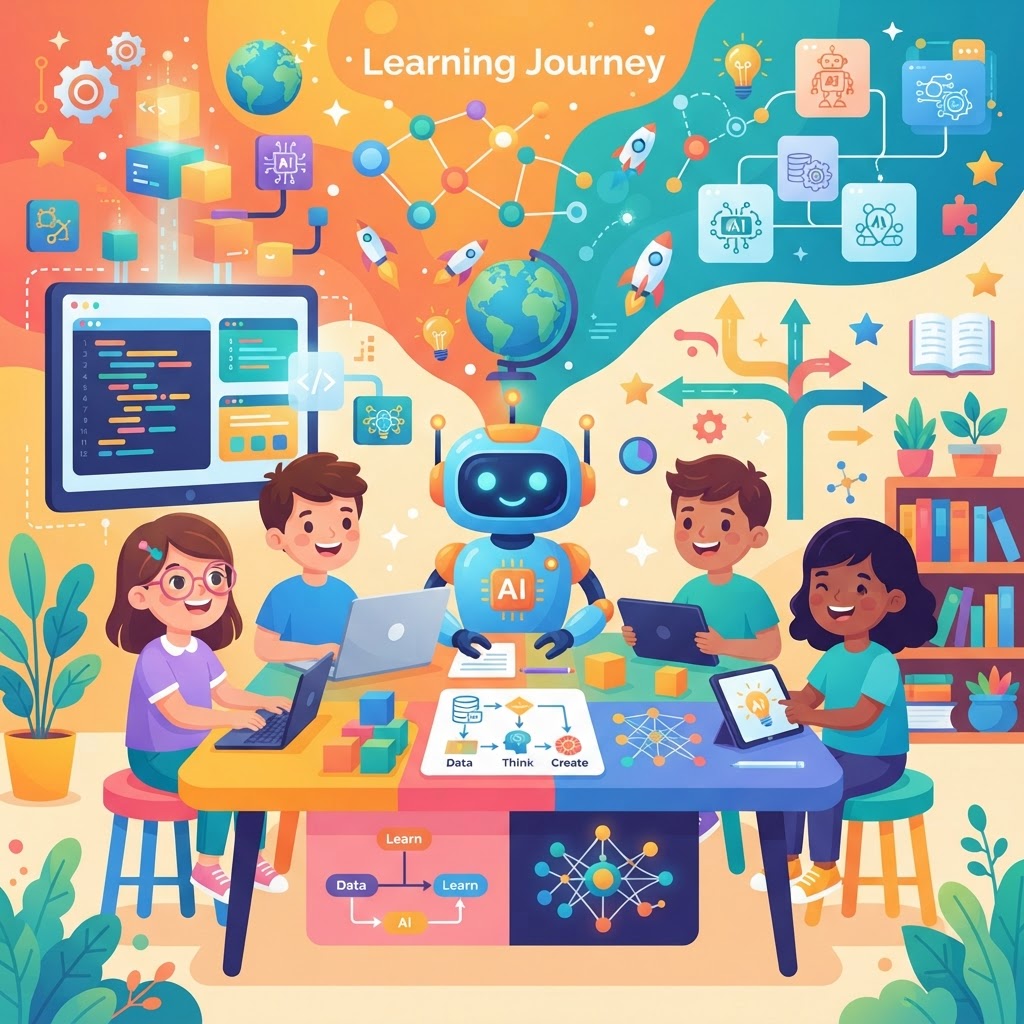
Why AI Literacy Matters for Young Learners
Artificial intelligence is no longer a distant concept from science fiction — it's woven into the apps children use daily, the recommendations they receive, and the world they're preparing to enter as future professionals. Yet most schools are still catching up when it comes to teaching AI fundamentals in a structured, age-appropriate way.
The good news? A growing library of free online resources makes it easier than ever for parents and educators to bring AI education home or into the classroom — without specialist knowledge or expensive subscriptions. Whether your child is six years old and just curious about how Alexa "knows" things, or fifteen and ready to build their first machine learning project, there's something out there for every stage.
This guide brings together the best free platforms, tools, and strategies to get young learners started on their AI journey today.
Top Free Platforms for Learning AI
1. Google's Teachable Machine
Google's Teachable Machine is one of the most accessible introductions to machine learning available — and it requires absolutely no coding. Children can train a simple AI model using their webcam, teaching it to recognise different hand gestures, sounds, or images.
Best for: Ages 9–16
Why it works: It makes the "magic" of AI visible and tangible. When a child holds up a red card and the computer correctly labels it, something clicks. They stop seeing AI as mysterious and start seeing it as a tool they can shape.
Pair this activity with a short discussion about how the AI "learned" — reinforcing the concept that machines learn from data, not instinct.
2. MIT's Scratch + AI Extensions
Scratch, developed by MIT, has long been a favourite for introducing children to coding. What many parents don't realise is that Scratch now supports AI-powered extensions — including text-to-speech, image recognition, and translation tools.
Best for: Ages 6–14
Why it works: The visual, block-based interface removes the intimidation factor completely. Children build games and stories while quietly absorbing how AI components can be layered into creative projects.
Look for community projects tagged with "machine learning" or "AI" to find ready-made examples your child can explore, remix, and learn from.
3. AI4K12 Initiative
The AI4K12 Initiative, a collaboration between CSTA and AAAI, offers a free curriculum specifically designed for K–12 learners. It's built around five core concepts — including how AI perceives the world, how it learns, and the ethical implications of its use.
Best for: Educators looking for structured lesson plans (Ages 6–18)
Why it works: The curriculum is academically rigorous yet practically designed for classroom use. There are ready-to-use activities, videos, and teacher guides that make implementation straightforward even without a technical background.
This is an excellent starting point if you're a teacher hoping to embed AI literacy across multiple subjects rather than treating it as a standalone topic.
4. GenAI Kids
For parents looking for a purpose-built learning environment, GenAI Kids offers structured, curriculum-aligned content designed specifically for children aged 6–16. The platform breaks down complex AI concepts into digestible lessons that grow with your child — introducing foundational ideas to younger learners before progressing to topics like neural networks, ethics, and generative AI for older students.
What sets GenAI Kids apart is the intentional age-staging. Rather than presenting a single experience to all children, content is thoughtfully tailored so that a seven-year-old and a thirteen-year-old both find material that feels relevant and engaging.
Supplementary Resources Worth Bookmarking
Beyond the headline platforms, a few other resources deserve a mention:
- Day of AI (MIT) — Free lesson plans exploring AI's real-world applications, ideal for middle school classrooms
- Machine Learning for Kids — A browser-based tool where children train AI models and then build projects in Scratch using those models
- CS Unplugged — For younger children, this collection of offline activities teaches computational thinking (the foundation of AI) without any screens at all
- YouTube: CrashCourse AI — A free video series that explains AI concepts clearly for teens and curious adults alike
Practical Tips for Parents and Educators
Finding great resources is one thing — actually making learning stick is another. Here's how to get the most from the tools above:
Start with curiosity, not curriculum. Ask your child where they've already seen AI in their life. Their answers — voice assistants, Netflix recommendations, photo filters — become natural entry points for deeper learning.
Make it hands-on as quickly as possible. Research consistently shows that children learn technology concepts best by doing. Even thirty minutes on Teachable Machine is worth hours of reading about neural networks.
Don't worry about knowing all the answers. Many of the best AI conversations happen when parents or teachers say, "I'm not sure — let's find out together." This models intellectual curiosity and removes pressure from the adult to perform expertise they don't have.
Connect AI to subjects your child already loves. Is your child passionate about art? Explore AI image generation tools and discuss how they work. Love sport? Look at how teams use AI for performance analysis. Relevance is the fastest route to engagement.
Use GenAI Kids as a home base. If you're unsure where to start, the platform's structured pathways give you a reliable framework to return to, while you supplement with the free tools listed above.
Key Takeaways
- Free, high-quality AI resources for children exist at every level, from beginner to advanced
- Google's Teachable Machine and MIT's Scratch are excellent hands-on starting points
- The AI4K12 Initiative provides structured, classroom-ready curriculum for educators
- Age-appropriate staging matters — look for resources that scale with your child's development
- Learning AI is most effective when it's curiosity-led, practical, and connected to real life
- Platforms like GenAI Kids offer structured progression alongside the broader free resource ecosystem
Start the AI Learning Journey Today
The window for building AI literacy is wide open — and starting early gives children an enormous advantage, not just professionally, but in how they think critically about the technology that increasingly shapes their world.
You don't need a computer science degree, an expensive course, or hours of preparation. Pick one resource from this list, set aside an afternoon, and explore it together. The best AI education begins with a single curious question.
Ready to explore further? Visit GenAI Kids to discover structured, age-appropriate AI learning pathways designed to grow alongside your child — from first curiosity to confident understanding.
Ready to Start Learning AI?
Join thousands of kids on GenAI Kids — free beginner lessons, no card needed.


