What Are Large Language Models? A Parent's Plain-English Guide: A Beginner-Friendly Roadmap
Demystify AI for your family. This beginner-friendly guide explains Large Language Models in plain English, helping you navigate the world of tech with your kids.
The AI Your Child Is Already Using — And What It Actually Does
If your child has ever chatted with ChatGPT, asked Siri a question, or used an AI writing assistant for homework, they have already encountered a Large Language Model — or LLM. These tools are woven into daily life faster than most of us expected, and as parents and educators, it's completely natural to want to understand what's actually happening under the hood.
The good news? You don't need a computer science degree to get it. This guide breaks down LLMs in plain, honest language so you can have informed conversations with your children, set appropriate boundaries, and even turn this technology into a learning opportunity.
So, What Exactly Is a Large Language Model?
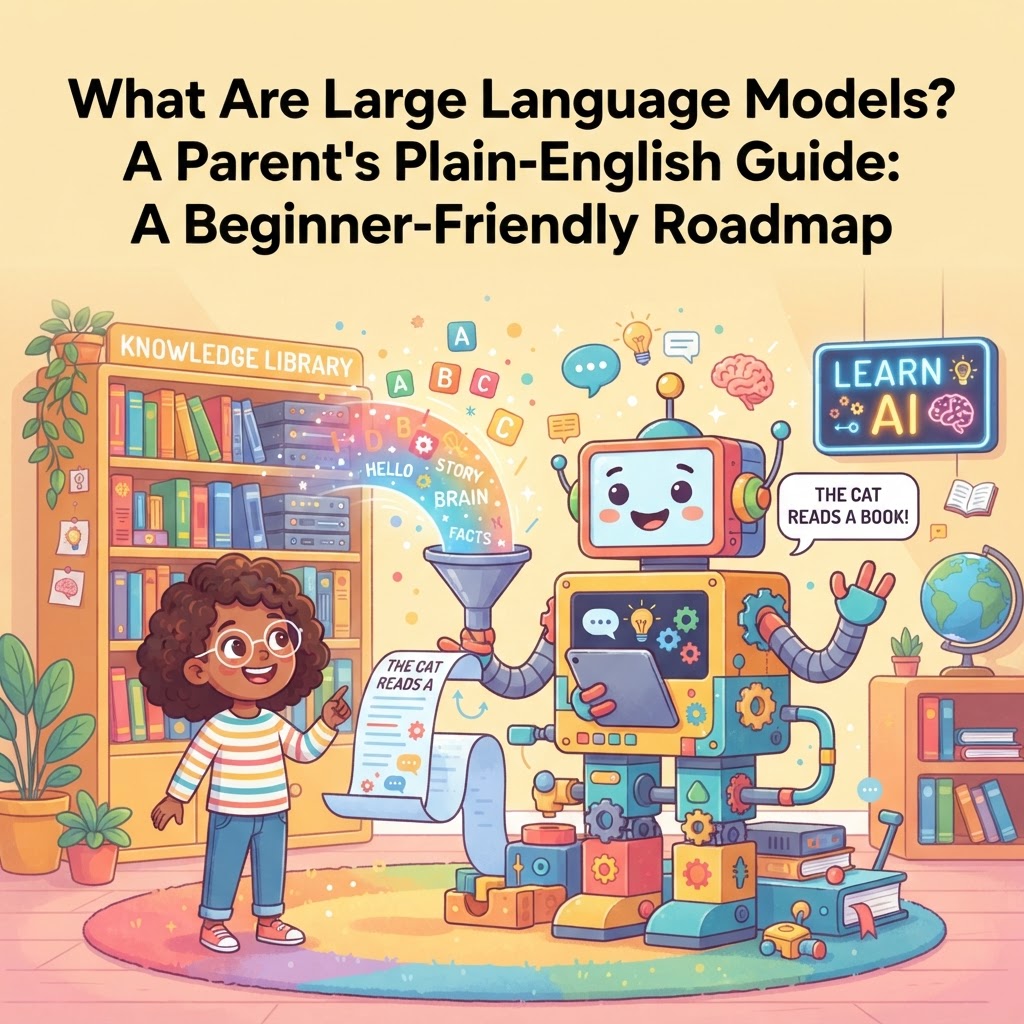
Think of a Large Language Model as an extraordinarily well-read text machine. It has processed billions of pages of books, websites, articles, and conversations — not to memorise them, but to learn the patterns of human language. From those patterns, it learns to predict what words logically follow other words, which is how it generates fluent, contextually relevant responses.
The "Autocomplete on Steroids" Analogy
You know how your phone suggests the next word when you're typing a text message? An LLM does something similar, just at a breathtaking scale and depth. When your child types "Can you explain photosynthesis?" into ChatGPT, the model draws on everything it learned during training to construct a response that sounds clear, accurate, and appropriately worded.
It's not "thinking" the way humans think. It has no feelings, no consciousness, and no genuine understanding. What it does have is an impressive statistical grasp of how language works — which makes it extraordinarily useful, and occasionally, surprisingly wrong.
Where Do LLMs Live?
LLMs power many tools your family may already use:
- ChatGPT (built on OpenAI's GPT models)
- Google Gemini (Google's conversational AI)
- Microsoft Copilot (integrated into Windows and Office)
- AI writing helpers built into apps like Grammarly or Canva
They're also increasingly built into educational platforms, search engines, and coding tools — which is exactly why understanding them matters right now.
Why Kids Are So Drawn to LLMs
Children are natural experimenters, and LLMs feel almost magical to them. You type a question, you get a thoughtful answer instantly. You ask for a story about a dragon who loves maths, and it appears in seconds. For curious, creative minds, that's genuinely exciting.
But there are a few reasons children engage with these tools so readily:
- Instant gratification — no waiting, no judgement
- Conversational interface — it feels like talking to someone, not using a tool
- Versatility — homework help, creative writing, game ideas, coding explanations
The challenge for parents isn't to dampen that enthusiasm. It's to channel it productively — helping children understand what they're working with so they use it wisely rather than blindly.
The Important Limitations Every Parent Should Know
Here's where many conversations between parents and children go wrong: adults assume children understand the limitations of AI, and children assume the AI is always right. Neither is true.
LLMs Can Confidently Get Things Wrong
This is called "hallucination" in AI terminology — when a model generates information that sounds authoritative but is factually incorrect. It doesn't know it's wrong. It has no internal fact-checker. This means a child using an LLM for a school project needs to verify key facts with reliable sources, just as they would with any reference tool.
They Reflect the Biases in Their Training Data
LLMs learn from human-generated content, and human-generated content contains human biases. This doesn't mean AI is inherently dangerous, but it does mean the outputs deserve critical evaluation — especially for older children who are developing their own worldviews.
Privacy Matters
Children should never share personal information — full name, school, address, passwords — with any AI chatbot. Most reputable LLM platforms have terms of service that restrict use by children under 13, so parental oversight is not just recommended, it's often required.
Practical Tips for Parents and Educators
Understanding LLMs is one thing. Knowing what to do with that understanding is another. Here are some actionable steps you can take today:
1. Have the "AI is a tool, not a teacher" conversation. Explain to your child that LLMs are helpful assistants, not sources of truth. Just like a calculator can't replace understanding maths, an AI writing tool can't replace learning to think and write.
2. Explore together, not separately. Sit alongside your child when they use AI tools, especially for the first time. Ask questions like, "How would you check if that's accurate?" or "What do you think about what it said?"
3. Use structured learning resources. Platforms like GenAI Kids are designed specifically to teach children how AI works in an age-appropriate, engaging way — giving them the vocabulary and critical thinking skills to be smart AI users rather than passive ones.
4. Set clear usage guidelines at home. Decide together when AI tools are appropriate (brainstorming, exploring ideas) and when they're not (replacing their own written work for assessment). Consistency here builds good habits.
5. Celebrate curiosity, redirect misuse. If you find your child over-relying on AI, respond with curiosity rather than punishment. Ask what they were trying to accomplish, then guide them toward a better approach.
For educators, GenAI Kids offers classroom-ready resources that align AI literacy with existing curricula — making it easier to introduce these concepts without overhauling your lesson plans.
Key Takeaways
- LLMs are pattern-recognition language tools, not thinking beings — they predict language, they don't understand it
- ChatGPT, Gemini, and Copilot are all powered by LLM technology your children likely encounter daily
- Hallucination is real — LLMs can generate confident, plausible-sounding misinformation
- Privacy boundaries matter — children should never share personal details with AI chatbots
- Critical thinking is the antidote — teaching kids how AI works empowers them to use it responsibly
- Guided exploration beats restriction — curiosity is an asset; the goal is informed, confident AI literacy
The Bottom Line: Curiosity + Understanding = Confidence
Large Language Models aren't going away. They're going to become more capable, more integrated, and more present in your child's educational and social world. The most powerful thing you can give your child isn't a strict "no" — it's genuine understanding.
When children know what AI is, how it works, and where its limits lie, they stop being passive users and start becoming thoughtful, critical participants in a world shaped by AI.
That's exactly the kind of future-ready thinking that resources like GenAI Kids are built to nurture — one curious child at a time.
Ready to start the conversation at home or in your classroom? Explore GenAI Kids' free resources and help your child become a confident, responsible AI citizen.
Ready to Start Learning AI?
Join thousands of kids on GenAI Kids — free beginner lessons, no card needed.


