What Are Large Language Models? A Parent's Plain-English Guide: Questions Parents Should Ask
Large language models are powering the AI tools your kids use every day. Here is a plain-English guide to help you understand them and the questions you should ask.
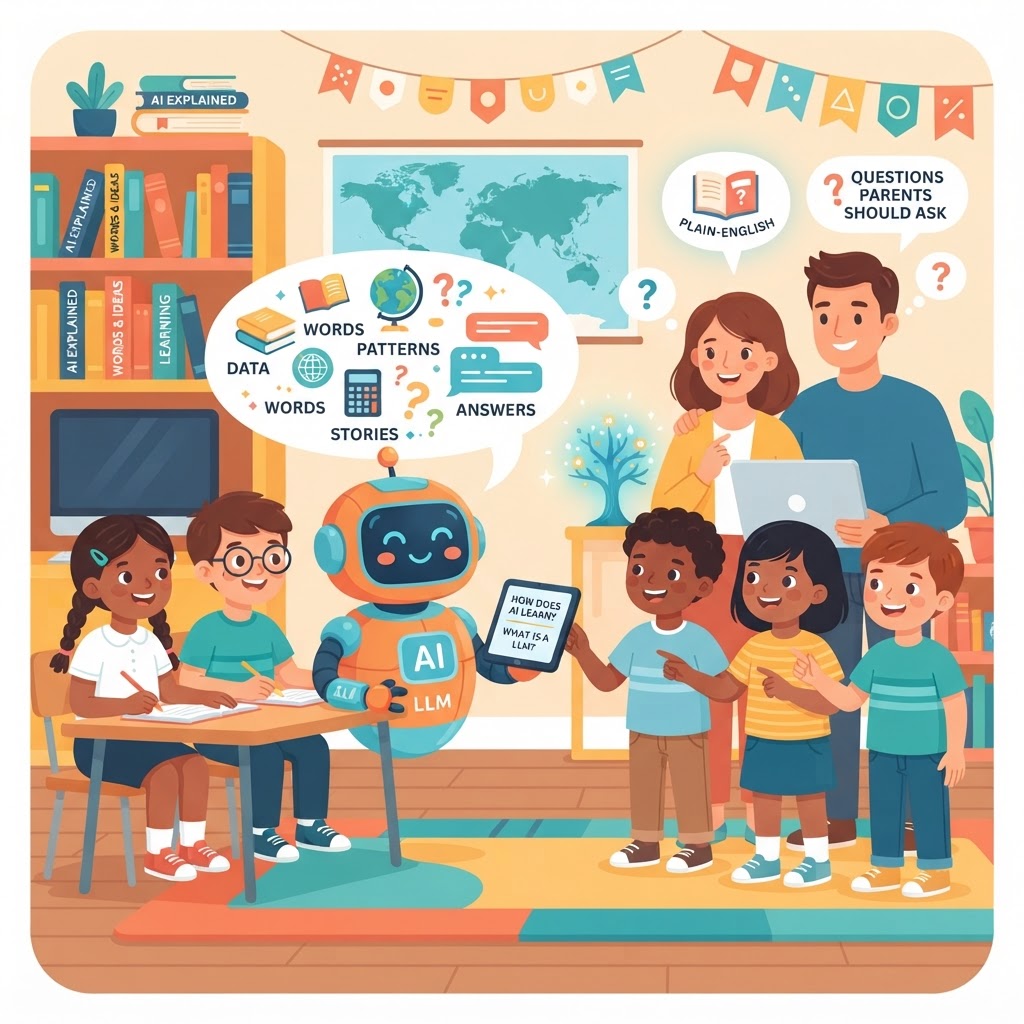
The AI Your Child Is Already Using — And What It Actually Does
If your child has ever chatted with ChatGPT, asked Alexa a question, or used an AI writing tool for homework help, they've already encountered a Large Language Model — or LLM. These systems are quietly woven into the apps, websites, and tools that millions of children use every single day.
The problem? Most parents have never been given a plain-English explanation of what these things actually are. Terms like "neural networks," "transformer architecture," and "training data" get thrown around in news articles, leaving many of us nodding politely while understanding very little.
This guide cuts through the jargon. By the end, you'll not only understand what LLMs are — you'll know exactly which questions to ask to keep your child safe and help them learn responsibly.
So, What Exactly Is a Large Language Model?
Think of an LLM as an extraordinarily well-read assistant that has consumed billions of pages of text — books, websites, articles, conversations — and learned to predict what words should come next in any given sentence.
That's genuinely it at its core. When your child types "Can you help me write a poem about dragons?" into ChatGPT, the model doesn't think the way a human does. Instead, it rapidly calculates the most likely helpful, coherent response based on patterns it absorbed during training.
A Simple Analogy That Works for All Ages
Imagine teaching a child to speak by reading them every book in a library — over and over again — until they could confidently complete any sentence you started. An LLM has done something similar, only at a scale no human could ever match. It has processed more text than a person could read in thousands of lifetimes.
This is why LLMs can write essays, answer science questions, translate languages, summarise documents, and hold surprisingly natural conversations. They are pattern-matching engines of extraordinary sophistication — but they are not thinking, feeling, or understanding in the human sense.
Why Parents and Educators Need to Understand This
Here's the crucial thing: LLMs sound confident even when they're wrong.
Because these models are optimised to produce fluent, plausible-sounding text, they can generate incorrect facts with the same smooth tone they use to explain something perfectly accurate. Educators call these errors "hallucinations" — the model essentially makes things up without knowing it's doing so.
For children using AI tools for homework, research, or creative projects, this creates a real risk. A child who doesn't understand how these tools work may accept AI-generated content at face value — missing historical errors, false citations, or subtly biased perspectives.
The Critical Thinking Connection
Understanding that an LLM is a pattern predictor — not an all-knowing oracle — is the foundation of healthy AI literacy. When children grasp this, they naturally start asking better questions:
- "Is this actually true, or does it just sound true?"
- "Where did this information come from?"
- "Should I check this with another source?"
At GenAI Kids, this is precisely the mindset the platform is built around. Teaching children not just to use AI tools, but to question them thoughtfully, is one of the most valuable skills we can give the next generation.
Questions Every Parent Should Ask (And Teach Their Child to Ask)
You don't need a computer science degree to have smart conversations about AI with your child. Here are the questions that matter most.
About the Tool Itself
- "Is this tool designed for children?" Many popular LLMs are built for adult professional use. Age-appropriate platforms have content filters and educational safeguards built in.
- "What data was this model trained on?" Most major LLMs were trained on broad internet data, which can include inappropriate or biased content. Knowing this helps you set expectations.
- "Does this platform store my child's conversations?" Privacy matters. Check the terms of service and privacy policy before your child creates an account.
About How Your Child Is Using It
- "Are you checking what the AI tells you?" Encourage children to verify key facts independently — especially for schoolwork.
- "Did you write this, or did the AI write it?" Open conversations about academic honesty now, before problems arise.
- "How did you decide the AI's answer was good enough?" This question builds the evaluative thinking children will need throughout their lives.
About Their Understanding
- "Can you explain to me how ChatGPT actually works?" If they can teach you, they truly understand it. If they can't, it's a great learning opportunity — together.
Practical Tips for Parents and Educators
Getting comfortable with AI as a family doesn't require technical expertise. Here are some straightforward starting points:
Start with curiosity, not fear. Banning AI tools entirely is rarely effective — children will encounter them regardless. A better approach is exploring them together and modelling thoughtful, critical use.
Set "AI homework rules" as a family. Decide together when AI assistance is acceptable (brainstorming, checking grammar, exploring a topic) versus when it isn't (writing an essay from scratch, completing a maths problem).
Use reputable, age-appropriate learning platforms. Resources like GenAI Kids are specifically designed to build AI literacy progressively — starting with foundational concepts for younger children and growing into more sophisticated topics for teenagers.
Stay curious yourself. You don't need to become an AI expert. But reading one well-written article a week, or watching a short explainer video, will keep you confident enough to guide your child's learning.
Talk about mistakes openly. When AI gets something wrong — and it will — treat it as a teaching moment, not a crisis. "Look, the AI got this wrong. How would we find the right answer?" is a conversation worth having repeatedly.
Key Takeaways
- Large Language Models are AI systems trained on vast amounts of text to predict and generate human-like responses
- LLMs do not "think" or "understand" — they are sophisticated pattern-matching tools
- They can produce confident-sounding errors ("hallucinations"), making critical thinking essential
- Children who understand how AI works are better equipped to use it responsibly and ethically
- Parents don't need technical expertise — asking the right questions is enough to guide safe, smart AI use
- Age-appropriate platforms and open family conversations are the most effective tools available to you right now
Your Next Step Starts With One Conversation
You don't need to understand neural networks to be a great guide for your child in the age of AI. You just need to stay curious, ask good questions, and create space for honest conversations.
The children who will thrive in an AI-powered world won't simply be those who can use these tools — they'll be the ones who understand what the tools are, what they can't do, and why that matters.
If you're looking for a structured, engaging way to build that understanding together, GenAI Kids offers a curriculum designed specifically to grow with your child — from first introductions to AI all the way through to responsible, critical digital citizenship.
Start with a conversation tonight. Ask your child: "Do you know how ChatGPT actually works?" You might be surprised by what you both end up learning.
Ready to Start Learning AI?
Join thousands of kids on GenAI Kids — free beginner lessons, no card needed.


